


 Cart
Cart
 sales@molnova.com


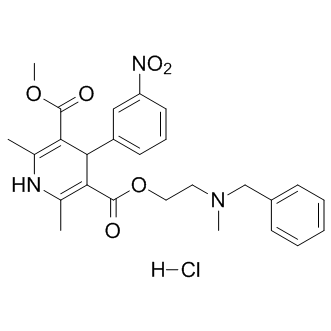
Nicardipine hydrochloride
CAS No. 54527-84-3
Nicardipine hydrochloride( YC-93 Hydrochloride )
Catalog No. M14959 CAS No. 54527-84-3
Nicardipine(YC-93) is a calcium channel blocker that has been widely used to control blood pressure in severe hypertension.
Purity : >98% (HPLC)
 COA
Datasheet
HNMR
HPLC
MSDS
Handing Instructions
COA
Datasheet
HNMR
HPLC
MSDS
Handing Instructions
| Size | Price / USD | Stock | Quantity |
| 500MG | 37 | In Stock |


|
| 1G | 43 | In Stock |
|
Biological Information
-
Product NameNicardipine hydrochloride
-
NoteResearch use only, not for human use.
-
Brief DescriptionNicardipine(YC-93) is a calcium channel blocker that has been widely used to control blood pressure in severe hypertension.
-
DescriptionNicardipine(YC-93) is a calcium channel blocker that has been widely used to control blood pressure in severe hypertension following events such as ischemic stroke, traumatic brain injury, and intracerebral hemorrhage.Hypertension Phase 3 Clinical(In Vitro):Nicardipine (0.1-10 μM; 24-48 h) reduces viability and proliferation of vascular smooth muscle cells (VSMCs) and inhibits their ability to migrate.(In Vivo):Nicardipine (0.3-10 mg/kg; p.o.) shows antihypertensive properties.LD50s of Nicardipine are 643 mg/kg (oral) and 557 mg/kg (oral); 18.1 mg/kg (intravenous) 25.0 mg/kg (intravenous); 735 mg/kg (subcutaneous) and 683 mg/kg (subcutaneous); 171 mg/kg (intraperitoneally) and 155 mg/kg (intraperitoneally) for male and female Sprague-Dawley rats, respectively.LD50s of Nicardipine are 187 mg/kg (oral) and 15.5 mg/kg (intravenous) for male Wistar rats, respectively.LD50s of Nicardipine are 634 mg/kg (oral) and 650 mg/kg (oral); 20.7 mg/kg (intravenous) 19.9 mg/kg (intravenous); 540 mg/kg (subcutaneous) and 710 mg/kg (subcutaneous); 144 mg/kg (intraperitoneally) and 161 mg/kg (intraperitoneally) for male and female mice, respectively.
-
In VitroCell Viability Assay Cell Line:VSMCs were isolated from New Zealand rabbit aortic preparations Concentration:0.1 μM, 1 μM, 3 μM, 10 μM Incubation Time:24-48 hours Result:Treatment reduced significantly cell viability and inhibited VSMCs proliferation in the presence of 10% FBS in a dose-dependent way, from 205.4±17.5% to 176.6±17%, 160.6±5.7%, 150.4±11.2%, 61.22±7.83% after 0.1 μM, 1 μM, 3 μM, 10 μM treatment, respectively. Western Blot Analysis Cell Line:BV-2 microglial cells Concentration:1, 3, 5, 10 μM Incubation Time:1 hours Result:Reduced LPS/IFN-γ- and peptidoglycan-induced iNOS expression and COX-2 expression in a concentration-dependent manners.
-
In VivoAnimal Model:In conscious normotensive rats (NR)Dosage:0.3-10 mg/kg Administration:P.o.Result:Induced a dose-dependent hypotensive response (maximal decrease in mean blood pressure, supine position) without any postural hypotensive response.
-
SynonymsYC-93 Hydrochloride
-
PathwayGPCR/G Protein
-
TargetCalcium Channel
-
RecptorAdrenergicReceptor|CalciumChannel|mAChR
-
Research AreaCardiovascular Disease
-
IndicationHypertension
Chemical Information
-
CAS Number54527-84-3
-
Formula Weight515.9859
-
Molecular FormulaC26H30ClN3O6
-
Purity>98% (HPLC)
-
SolubilityDMSO: ≥ 35 mg/mL
-
SMILESCC1=C(C(C(=C(N1)C)C(=O)OCCN(C)Cc2ccccc2)c3cccc(c3)[N+](=O)[O-])C(=O)OC.Cl
-
Chemical Name3,5-Pyridinedicarboxylic acid, 1,4-dihydro-2,6-dimethyl-4-(3-nitrophenyl)-, 3-methyl 5-[2-[methyl(phenylmethyl)amino]ethyl] ester, hydrochloride (1:1)
Shipping & Storage Information
-
Storage(-20℃)
-
ShippingWith Ice Pack
-
Stability≥ 2 years
Reference
1. Huang BR, et al. PLoS One. 2014 Mar 12;9(3):e91167.
2. Amenta F, et al. J Hypertens Suppl. 1996 Oct;14(3):S29-35.
3. Gasior M, et al. J Neural Transm. 1996;103(7):819-31.
molnova catalog



related products
-
OPC 8490 free base
OPC 8490 free base is a novel positive inotropic vasodilator and a cardiotonic agent that increases Ca currents in a dose-dependent and reversible manner and can be used to study cardiovascular diseases.
-
Hypophyllanthin
Hypophyllanthin and phyllanthin have antitumour effects against Ehrlich Ascites Carcinoma in mice.
-
Cis-22a
Cis-22a is a TRPV6 inhibitor (IC50 = 0.32 μM), which exhibits selectivity against related TRPV channels and calcium channels. cis-22a displays antiproliferative effects on T47D human breast cancer cells.
